
Macro for Muscle Gain: Best Ratios and Guide 2026
You want to gain your muscles, but you don’t get the expected results? The main reason for this is the usage of the wrong macro for muscle gain. Macros means carbohydrates, fats and proteins that are very important for muscle recovery, muscles building and body energy. Most of the people only focus on the workout only and completely ignore their diet. So the muscle growth can become slow.
If you want to build muscle it is very important to give the proper nutrients and calories to the body. A balanced diet has high protein, muscle energy for the carbs, workout support for healthy fat are very important. If you are a beginner or a regular at the gym, usage of the right macro for muscle gain is very important if you want to get better results. Here we discuss the best macro ratios, the right way to calculate the macros and which proper nutrition supports muscle growth in 2026. calculate macros for muscle gain.
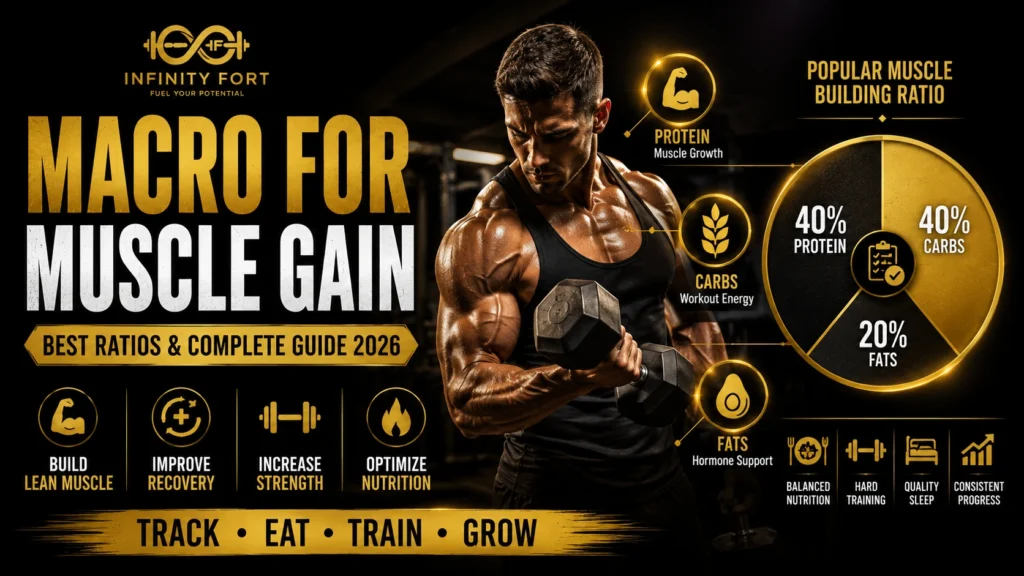
What Are Macros and Why Do They Matter for Muscle Gain?
Macros are the short form of macronutrients, in which proteins, carbohydrates, and fats are included. These nutrients give energy to the body and help to proper work for the body functioning. It is very important to understand macros for muscle gain because the nutrients play a different role in muscle building.
Protein.
After workout, proteins are very important to repair and grow the muscles again.
Carbohydrates.
The body provides energy after the gym session and training. Carbohydrates Calculator.
Healthy fats.
It supports hormones like testosterone that play a very important role in muscle growth.
Tip:
If your macro intake is not balanced, it can be difficult to gain muscles with exercise. So, you have to follow the macro for a muscle gain plan for better results and healthy muscle growth.
How to Calculate Macro for Muscle Gain
It is very important to calculate the macro for muscle gain in the right ratio.Too much eating is not enough. It is important to get a balanced diet according to your body’s requirements. After calculating the macros, you get the knowledge about how many calories and nutrients you have to take for muscle recovery, strength, and improvement.
Step 1.
First of all you have to calculate the calorie requirement according to your age, weight, height, activity level and goal. For bulking, 250 to 500 calories is needed.
Step 2.
Proteins are very important for muscle building. Usually 1.6 gram to 2.2 gram per kg body weight is recommended.
Step 3.
Carbs give you workout energy. For muscle gain, moderate to high carbs are necessary like 40% to 55% calories.
Step 4.
Fats are very important for hormones and recovery. Taking the daily calories, 20% to 30% from the healthy fats is the best option.
Step 5.
You can make the final diet plan by dividing the total calories into fat, carbs and proteins.
How Much Muscle Can You Gain With Proper Macros?
If you follow the proper macro for muscle gain planning. So this process can be slow but steady. Beginners progress easily faster, but in the advanced level, the gain process is slow.
- Beginners can gain 1 to 1.5 kg muscles per month.
- Intermediate lifters can gain 0.5 to 1 kg per month.
- Advanced lifters can gain 0.25 to 0.5 kg per month.
Proper macros help you to control the fat gain, muscle recovery, and build a lean physique. Because muscle gain is not dependent on the diet only, training and consistency is also very important.
Best Macro Ratios for Muscle Gain
If you want to gain muscle, it is not enough to eat too much. It is very important to calculate the macro for muscle gain. You should take the right amount of proteins, carbohydrates, and healthy fat to your body. Muscle recovery can be better by proper macro planning, and can improve the strength and easy to gain the muscle mass. Because a macronutrient calculator for muscle growth can depend on the weight, workout, fitness goal, and activity level.
1. Classic Bodybuilding Split (40P / 40C / 20F)
This ratio is very important for traditional muscle building. 40% protein, 40% carbohydrates, and 20% fats are included in this. This is the best approach for the people who take regular gym training and build lean muscle.
| Macronutrients | Percentage |
| Protein | 40% |
| Carbs | 40% |
| Fats | 20% |
2. Higher Protein Focus (45P / 35C / 20F)
If you want to build and gain lean muscles, and control fat gain. So, a high protein macro ratio is very helpful for you. By using this plan, the quantity of protein is high, which is very supportive to muscle recovery and repair.
| Macronutrients | Percentage |
| Protein | 45% |
| Carbs | 35% |
| Fats | 20% |
3. Carb‑Heavy for Hard Gainers (35P / 50C / 15F)
The persons who are naturally slim and their metabolism are fast, so the high carb intake is very beneficial for that type of people. Because carbs give the extra energy that is very beneficial for muscle building and workout. This is the best for the fast metabolism and skinny body type.
| Macronutrients | Percentage |
| Protein | 35% |
| Carbs | 50% |
| Fats | 15% |
4. Balanced Strength Gain (40P / 45C / 15F)
This ratio improves the muscle and strength both and is considered as a balanced option. The carb amount is more that is very helpful for better performance, workout better performance. This is the best for the heavy gym session and hard training.
| Macronutrients | Percentage |
| Protein | 40% |
| Carbs | 45% |
| Fats | 15% |
5. Customized Approach (Based on Training Phase)
Customized approach of training phase and body of every person is totally different. So a customized macro approach can be best. Like:
- Bulking calorie phase :
higher carbs and calories are needed.
- Lean bulk:
high protein and moderate carbs are needed.
- Cutting phase:
controlled carbs and high protein is very useful.
If you are a beginner, you have to start with the balanced macro and then adjust the macros according to the results.
Training phase macro chart.
Bulking phase:
| Macronutrients | Percentage |
| Protein | 35% |
| Carbs | 50% |
| Fats | 15% |
Cutting phase:
| Macronutrients | Percentage |
| Protein | 45% |
| Carbs | 30% |
| Fat | 25% |
Lean bulk :
| Macronutrients | Percentage |
| Protein | 40% |
| Carbs | 40% |
| Fat. | 20% |
These macro ratios help you in muscle gain, but for the best results, proper sleep, hydration, calories, and workout is very necessary.
Sample Macro Plans for Muscle Gain
It is very important for muscle gain. Macro planning is very important for muscle gain because everybody’s requirements are different. Here are some sample macro plans discussed below that you can adjust according to your height, weight, activity level and goal. Sample macro chart for muscle gain.
| Body Weight | Calories | Protein | Carbs | Fats |
| 55-65 kg | 2000-2300 kcal | 100-120g | 220-280 g | 50-70 g |
| 65 – 75 kg | 2300 to 2600 kcal | 120 – 150g | 250 – 320 g | 60 – 80 g |
| 75 to 90 kg | 2600 to 3000 kcal | 140 to 180 g | 300 – 380 g | 70 – 90 g |
This is the general guide for the person. If you are doing intense gym training, carb and protein can be increased slightly. Macros calculator for weight loss and muscle gain is necessary.
Pro tips About Using Macro for Muscle Gain
Macros are not just a number, it is the proper strategy and planning that gives your muscle growth effectively and fast. Some pro tips can be beneficial for the proper results. If you follow these tips, you can get better results discussed below.
Track Your Macros Consistently
Consistency is essential for macro tracking. You have to track your daily protein, carbs, and fats. You can monitor your macro intake by using apps or simple food diaries. By using this, you can easily check that you are not over eating.
Do not Ignore Hydration and Sleep
Muscle growth is not just from the diet. Hydration and sleep recovery is very important for proper muscle growth. Take proper sleep in quality time. Taking 7 to 9 hours of sleep and proper water intake can make the muscle repair and make it strong. Proper hydration makes the body fit for proper functioning.
Focus on Protein Timing
To take the proteins, quantity is not important but timing is also very important. After workout, protein intake can make the muscle recover. To divide the protein 3 to 5 meals on a full day is the best strategy for you.
Prioritize Whole Food Sources
Whole foods like chicken, rice, oats, fruits, vegetables should be prioritized as compared to processed food. These foods provide clean nutrition that is very beneficial for long-term muscle gain. Natural food should be prioritized as compared to processed food.
Adjust Macros Based on Progress
The reaction of everybody is different. If you don’t see any progress in two to three weeks, you have to increase your carbs and calories slightly. If your fat gain is more, you have to reduce the carbs. This adjustment is needed if you want effective results.
Combine With Strength Training
It is not enough to follow the macro for muscle gain only, but it is also very important to combine it with strength training. Weight lifting and resistance exercise helps to grow the muscles, whereas healthy carbs, fats, and protein gives energy and recovery. For the best results, you have to follow both a workout and balanced diet. Progressive overload is the key for muscle growth. You have to include the bench press, deadlift, and squats in the gym.
Conclusion
Only a gym and heavy workout is not enough for muscle gain. But to understand the macro for muscle gain and plan your diet properly is very essential. When you include the right amount of carbs, protein, and healthy fat in your diet, your body gets the complete recovery, repairs the muscles, and builds lean muscle mass gradually. Protein muscle helps in repair and growth because carbs give energy for the workout, that gives the healthy fat. Healthy fats support the overall body performance and hormones.
If you start to take in more calories without any planning, there is a chance of unnecessary fat loss and muscle gain. But when you calculate the macro for muscle gain properly and follow it, you can build lean muscle with the controlled fat. Because every person, body type, workout intensity, fitness goal and metabolism is totally different, so macros are not the same.
To make the best macro plan according to the body’s weight and activity level is the best approach. Consistency is also important for muscle building. If you do the regular workout and take proper and follow the proper balanced diet, take proper sleep, so a macro for muscle gain can maintain the plan consistently. So you get better results with time.
FAQs
- How many macros should I eat for muscle gain
For muscle gain, the ideal macronutrient ratio depends on your body requirement and goal. Here are some general guidelines. Discuss here protein 1.6 grams to 2.2 grams per kg that can repair your muscles and be helpful in your muscle growth. Carbs 40% to 55% for workout energy. Fats 20% to 30% of total calories important for the hormones and recovery. This balance helps you to control fat and muscle gain
- Can I gain muscle without counting macros?
Yes, you can gain muscle without counting the macros, but results can be controlled slowly or less if you only follow the healthy eating without any tracking. So, it can be possible that you can overeat or under-eat. Macro counting gives you a clear structure about your diet plan.
- Is protein more important than carbs for muscle growth?
Proteins are very important for muscle building and carbs also play very important for muscle gain. If you have consumed low carbs, your workout performance can be weak. So it is important to balance both.
- How long does it take to see results from macros?
Macro for muscle gain results can be visible usually from 3 to 6 weeks. Energy level can be improved, physical performance can be improved. Body composition can be changed slowly. Muscle visible growth can be noticed in eight to twelve weeks.
- Do I need different macros for bulking vs. cutting?
Yes, cutting and bulking macros differ and can be different. In bulking, calories and higher carbs have to be consumed, but in cutting, calories deficit, high protein but lower carbs are included. Goals are different in both phases, so macro adjustment is necessary.
- Are macro calculators accurate for everyone?
A free macro calculator gives the estimate idea, not a hundred percent it’s sure the exact result. Because everybody has different metabolism, genetics, and activity level. So the calorie calculator to build muscle is very important for the initial stage, but adjustment is needed on the progress base.
- Can women use the same macro ratios as men?
Yes, women can use the same macro for muscle gain ratios, but total calories are usually low because there is a difference in the metabolism and body size. Protein, carbs, and fats ratio can be the same, but quantity adjustment is needed according to the body requirement.